















Sometimes the distance of thousands of miles makes the pain of your homeland even sharper. As a Pakistani living overseas, I watch events unfolding in Pakistan with deep concern. Like millions in the Pakistani diaspora, I remain emotionally tied to the country of my birth, and today many of us fear that its democratic foundations are being dangerously weakened.
For more than two years we have watched with growing alarm as former prime minister Imran Khan remains imprisoned, his wife faces legal cases, and thousands of political workers associated with Pakistan Tehreek-e-Insaf (PTI) have been arrested. For supporters like myself, this is not simply about one leader or one party. It is about the future of democracy, justice, and the rule of law in Pakistan.
Imran Khan’s political rise inspired millions, especially young Pakistanis who believed the country could break free from corruption, dynastic politics, and elite control. Whether one agrees with all of his policies or not, it is undeniable that he energized political participation on a massive scale. Yet today the man who once served as prime minister remains behind bars, facing a series of legal battles that many supporters believe are politically motivated.
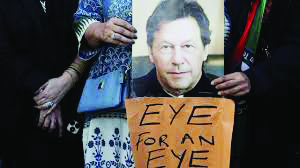
Equally troubling are reports regarding restrictions surrounding his imprisonment and health care. A report submitted to Pakistan’s Supreme Court by an attorney has alleged that a four-month delay in providing proper medical treatment for an infected eye led to former prime minister Imran Khan losing nearly 85 percent of the vision in that eye. According to the report, the condition requires specialized treatment that cannot be adequately provided inside prison facilities. Supporters and legal representatives have called for his transfer to Shifa International Hospital, where advanced treatment is available under the supervision of his personal physician, but authorities have so far not permitted such care. If these claims are accurate, they raise serious humanitarian concerns about the treatment of a prisoner and the basic right to timely medical care.
The imprisonment of thousands of political workers has further deepened concerns about political freedoms in Pakistan. Political activism is a fundamental right in any democracy. When citizens fear arrest for supporting a political party or attending rallies, democratic participation itself is threatened. The philosopher Voltaire is often associated with the defense of free speech: “I disapprove of what you say, but I will defend to the death your right to say it.” Democracy does not mean eliminating opposition. It means allowing the people to decide.
One of the most symbolic moments in Pakistan’s recent political struggle came when PTI was denied its iconic election symbol—the cricket bat. For many voters, particularly in rural areas, party symbols help identify candidates on the ballot. Removing that symbol was widely seen by supporters as a serious blow to electoral fairness.
Yet despite these obstacles, candidates supported by PTI still secured significant success in the election. For many Pakistanis this demonstrated that the political movement around Imran Khan remains deeply rooted among the public. As Abraham Lincoln famously said, “Elections belong to the people.” When the will of the people is constrained, democracy itself suffers.
Pakistan’s internal political crisis is unfolding at a time when the world itself faces growing instability. Conflicts in the Middle East, including tensions between Iran and Israel, have heightened fears of wider regional conflict.
For many in the Muslim world, these developments have intensified a sense that the global Muslim community lacks unified leadership.
Imran Khan has consistently spoken about justice for oppressed peoples, particularly regarding the suffering in Gaza and Palestine.
He stated on record that recognizing Israel under conditions of occupation would be like “stabbing the oppressed people of Palestine in the back.” Supporters believe Pakistan under his leadership would have continued advocating for justice while avoiding alignment with oppression in global conflicts.
For Pakistanis living abroad, watching these events unfold has been deeply painful. Many of us left the country seeking opportunity, yet our emotional ties to Pakistan remain strong. We want institutions that are independent, courts that are fair, and a political system where leaders are chosen by the people. Pakistan’s youth deserve a future defined by opportunity and hope.
As Nelson Mandela once said, “Justice is the foundation of freedom.” For millions of Pakistanis at home and abroad, the hope
remains simple: that Pakistan will emerge from this difficult period stronger, more just, and more faithful to democratic principles.
Because the future of a nation cannot be built on power alone
it must be built on justice.
By: Nayyar Sohail
PTI – BC, Canadaa