



















By: Hasan A. Rabbani Gr 9
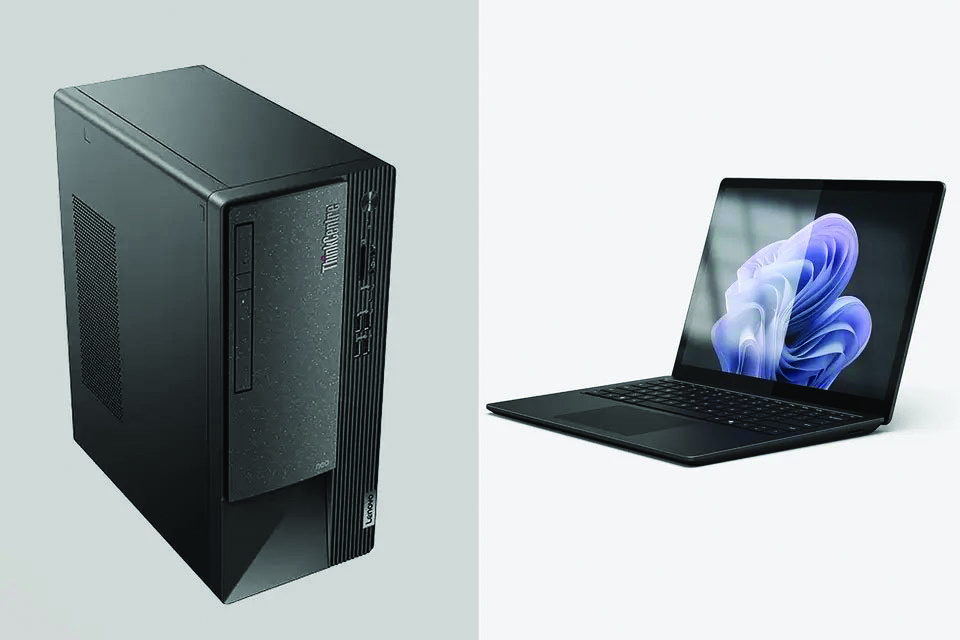
10 years ago, if you cared about gaming and work, you’d buy a desktop computer.
They dominated in power, support, and quality, but the narrative is different now. The lead desktops once held are diminishing due to a plethora of reasons. Especially in 2026, there is little reason to buy a desktop computer. With the state of the market, record-high prices and a close gap, desktops are becoming less attractive over time.
Desktops still offer some benefits, including flexibility, performance, and repairability. Many people prefer the flexibility of a desktop, as it allows you to build and customize it to your liking.
However, you’ll inevitably run into issues while building your own or be forced to pay a premium for a
pre-built desktop.
Laptops have their own definition of flexibility, usable on a desk, on your bed, in the car, and anywhere else you go.
Desktops are obviously larger, louder, and heavier than a simple console or a laptop; however, this allows them to cool themselves and perform better. Still, laptops are closing the gap through software-based performance-boosting technologies that are compatible with even older machines. For most consumers, this minor performance loss won’t be an issue.
Upgradability and repairability are two categories where desktops are unmatched. The same parts can be used for decades, and upgrading components is exceptionally straight forward. It can be as simple
as unscrewing, unplugging, installing your new part, and re-screwing. Repairing laptops is more challenging because of less flexibility and overall control.
However, desktops are starting to be influenced by pressures that are affecting how easy it is to find parts.
This issue goes beyond desktops and laptops. The entire tech industry has been hit by two major
shortages, forcing people and companies to change the way they get their hardware. One of these issues is the radical shortage of RAM, random access memory. Random access memory is a computer’s extremely fast, short-term memory. It stores all of the code behind webpages, and it stores rendering information, like animations or parts of the map in a video game.
Even a GPU, a part of the computer, has its ownRAM. Almost all technology requires RAM; a smart TV, your car’s screen and recently, AI data centers.
are just some of the millions of devices that use RAM.
Due to the boom in AI data centers and the RAM they require, in late October of 2025, prices shot up. Manufacturers are struggling to produce RAM while demand is at record highs. Prices have gone from $150 to even $800! Companies are debating pulling out of the consumer market to focus exclusively on the AI market.
There are no signs of prices deflating or slowing down for at least the next year ahead of us, while demand continues to rise. Companies are struggling, small businesses and multi-billion-dollar
giants alike. Samsung failed to buy RAM from itself; the semiconductor manufacturing division denied a manufacturing deal from the mobile division. The crisis has been going on for almost 3 months, and
prices continue to rise.
Nevertheless, this is only one of two issues.
As if a desktop wasn’t already expensive enough, NVIDIA announced a 40% cut in production of its latest graphics processing units. A graphics processing unit, or GPU, is essential to every computer; it outputs the display and calculates what each pixel looks like. A GPU is typically the most expensive part of a computer, and NVIDIA leads the market in consumer graphics cards. NVIDIA is the most valuable company in the world, but only because of their AI chips, where they make almost 80% of their money.
NVIDIA knows people are willing to pay outrageous prices for their GPUs. In January of 2025, they withheld the supply of their new GPUs to mark up prices by thousands, and it took almost 8 months
for prices to deflate. People speculate that this production cut is another scheme to mark prices up and reinvest in AI. Nonetheless, this is choking the GPU supply. When NVIDIA announced the RTX 5090, NVIDIA’s top consumer card, they set its price at 2,000USD, but currently it is selling for almost
5000CAD! Various companies are trying to challenge NVIDIA’s monopoly-like hold over the market,
but none are coming close.
Obviously, these shortages will raise prices for all types of computers and consoles, but some will be affected less than others.
Both laptops and consoles use special types of GPUs and RAM, and
manufacturers buy in bulk, so their prices will rise less. Desktop manufacturers are in direct competition
with AI data centers for RAM, and will experience the full extent of both shortages.
At this point, it’s well established that a desktop will cost you more, but desktops come with even more “hidden” costs that are important to factor in. When buying a laptop, you don’t need any extra accessories, at most a mouse and a small mouse pad. When buying a desktop, you need to factor in a monitor, a mouse, a keyboard and a mousepad at minimum.
A desk and chair, if you don’t already have one, a webcam and some headphones or speakers will all add up quickly. From a ground-up setup, you can spend more than $400 on just parts to support the desktop, instead of putting that money into getting better hardware. Price isn’t even close to being a debate.
Desktops are not entirely obsolete; they’re completely viable in a handful of situations. For example, if you play niche and extremely competitive games that require the best performance, lowest delay, and/or extensive accessories, a desktop will prove to be better. If your work requires full use of your computer’s hardware, such as rigorous 3D
rendering or AI learning, a desktop will prove better.
However, for the rest of the population, the 95% who will have no issues with the performance of a console or laptop, a PC is rarely the best option. In other words, desktops aren’t the future of computing.


