













ICC formally declines Bangladesh’s request to play in Sri Lanka:
By Sqn. Ldr. Nusrat Hussain (Retd)
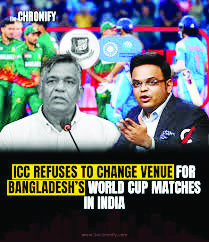
In a latest development, the ICC has formally declined Bangladesh’s request to play in Sri Lanka and has asked Bangladesh to respond by tomorrow. Early indications suggest Bangladesh is inclined to boycott the event altogether. Pakistan had earlier signaled support for Bangladesh’s stance, raising the prospect of a dual withdrawal—an outcome that would severely damage the credibility of the tournament.
Cricket has long been celebrated in South Asia as a gentleman’s game, a sport capable of softening political tensions rather than inflaming them. Yet recent developments reveal how state power and institutional influence are shaping cricket in ways that undermine its neutrality and threaten its unifying potential.
The slide began when India declined to tour Pakistan for the Asia Cup 2023, citing terrorism and security concerns. The decision forced Pakistan’s fixtures to be shifted to neutral venues and set a precedent whereby political calculations trumped the spirit of sporting engagement. Ironically, Pakistan has endured far more terrorist attacks than India, many linked to Indian involvement or support. Yet Pakistan has not used terrorism as a pretext to cut cricketing ties. If terrorism were the sole criterion, neither side could justify tours; the difference lies in who chose to weaponize it.
This stands in sharp contrast to 1987, when President Zia-ul-Haq flew to India under the slogan “Cricket for Peace” during a military standoff. It served as Cricket Diplomacy at that time. Today it serves as leverage.
The trend continued during the Asia Cup 2025 final in Dubai, when Indian players abstained from post-match handshakes and declined to receive their trophy from Mohsin Naqvi, President of the Asian Cricket Council. That trophy remains uncollected at the ACC office months later. One may debate whether Naqvi should have insisted on protocol, but it is harder to justify refusing a basic cricketing ceremony in a sport that prides itself on decorum.
The latest dispute surrounds the ICC Men’s T20 World Championship 2026, co-hosted by India and Sri Lanka. Under existing arrangements, all Pakistan matches—including a potential final—will be held in Sri Lanka.
Matters escalated when Bangladeshi fast bowler Mustafizur Rahman, contracted by Kolkata Knight Riders, was asked to withdraw after a mob lynching incident in Bangladesh. Authorities in India claimed they could not ensure his security. Bangladesh responded by refusing to play matches in India on identical grounds and offered a clean solution: swap its group with one based in Sri Lanka. No logistical disruption, no broadcast disruption. Yet the ICC rejected the proposal and insisted Bangladesh play in India.
One cannot ignore the institutional optics. The ICC is chaired by Jay Shah, son of India’s Home Minister Amit Shah, creating an unavoidable perception of influence. Sixteen other cricketing nations sit on the Council, yet few appear willing to challenge the direction of decisions involving India.
What makes this politicization even more tragic is the disconnect between elite narratives and everyday reality. Cricketers from both countries often speak of overwhelming affection across the border. In Pakistan, restaurant owners and shopkeepers have refused to accept money from Indian players. Pakistani cricketers have described similar warmth in India. The common man is not manufacturing hostility; politicians are. The political class hates on the public’s behalf, and then sells that hatred back as patriotism.
The broader pattern is familiar: militarily or financially dominant states shaping global norms to suit national interests, while smaller states increasingly push back. The difference today is that weaker voices are no longer entirely silent.
Cricket commands billions of admirers. It can remain one of the few shared cultural spaces that still unite South Asians—if neutrality and basic respect are defended. Otherwise, cricket risks becoming yet another casualty of politics—dividing where it once connected, and diminishing where it once elevated.
This situation raises an important question: how should Pakistan respond if Bangladesh walks away? Boycotting in solidarity would create headlines but it would also hand India and the ICC a convenient scapegoat. A more prudent course would be for Pakistan to continue participating while wearing black armbands to register symbolic support for Bangladesh and to highlight the double standards at play. Such a gesture is subtle, dignified, and diplomatic—denying India the comfort of uncontested narratives while avoiding self-isolation.


