
















“Temporary tax breaks don’t fix inflation — they postpone it and make it worse.”
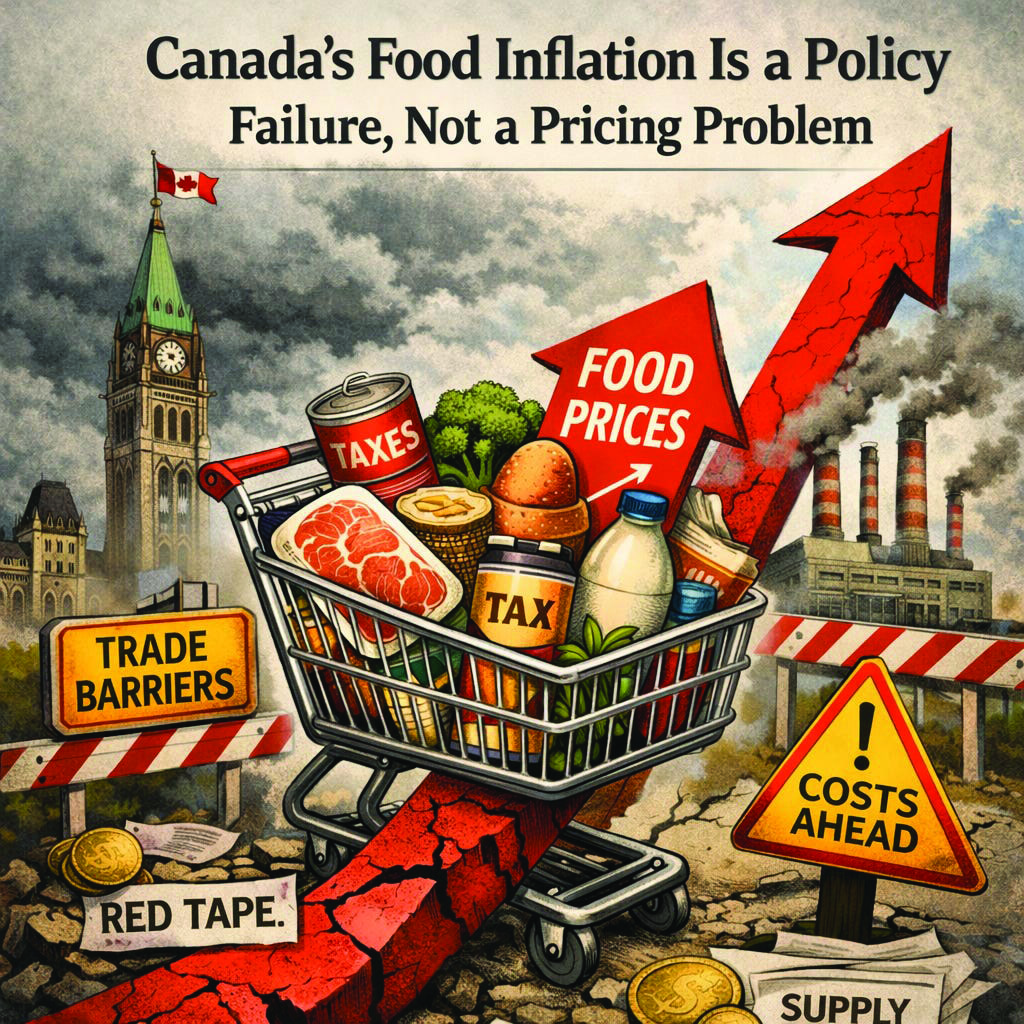
Food prices in Canada rose 6.2% year over year in December, with grocery store prices up 5.0% and restaurant prices jumping 8.5%. That alone would be troubling. What makes it more alarming is that inflation came in well above expectations, pushing Canada to its highest food inflation rate since August 2023.
According to the latest internationally comparable data,
Canada now sits at the top of the G7 for food inflation. The numbers speak for themselves: Canada at 6.2%, Japan close behind at 6.1%, followed by the United Kingdom at 4.2% and the United States at just 3.1%. Italy, France, and Germany are all hovering below 3%. It makes little sense that food inflation in Canada is roughly double that of the United States, especially given that Washington has embraced tariffs and trade confrontation far more aggressively than Ottawa. If tariffs were the main driver, the U.S. should be leading this unfortunate ranking. It isn’t.
Tax relief comes with a cost
Part of December’s spike can be explained by the GST holiday, which applied for 17 days of the month. Temporary tax relief often feels good in the moment, but it comes with a cost: pricing volatility. When taxes are suspended and then reintroduced, price signals become distorted. Retailers and suppliers adjust — sometimes conservatively, sometimes opportunistically. Only now can we properly measure those effects, and the results are not encouraging.
Dr. Sylvain Charlebois
Source: torontosun.com/opinion/


