


















Hajj is the sacred pilgrimage performed by Muslims at the holy mosque of Masjid al-Haram in Makkah, Saudi Arabia. It is one of the five pillars of Islam, which means that it is obliged of every Muslim at least once in their lifetime (so long as they have the means). Hajj takes place during the same period each year – during the month of Dhul Hijjah, the twelfth month in the Islamic Calendar. Hajj begins on the 8th of Dhul Hijjah and lasts until the 13th .
This year, Hajj is is expected to take place between 4th June to the 9th June 2025 in the Gregorian Calendar, depending on the sighting of the moon.
The Islamic calendar operates on the
lunar cycle, which is why it appears to shift forward approximately 11-12 days each year as it corresponds to the Gregorian calendar. As Muslims, undertaking Hajj in Islam – is a spiritual duty, as long as we are financially, physically, and emotionally able to do so. While it is only required of Muslims to perform the Hajj at least once in their lifetimes, it can be performed multiple times.
History Of The Hajj
In 628 CE, the Prophet Muhammad (peace and blessings be upon him) and the Muslims embarked on the first Islamic Pilgrimage (Hajj), re-establishing the traditions started by the Prophet Ibrahim (AS), who first began the tradition of Hajj millennia before.
The story of Hajj begins with the story of Ibrahim (AS) and the commandment of Allah (SWT) to travel to the barren desert of Makkah and leave his wife Hajar and infant son Ismail (AS). They followed the commandment of Allah (SWT). Hajar and Ismail (AS) quickly ran out of resources, and in a desperate effort to find water, Hajar ran between the two neighbouring hills of Safa and Marwa in search of someone who could help or nearby water. She did this seven times, only to return to a crying Ismail (AS) empty handed.
As the infant baby cried, Ismail (AS) struck the ground with his leg, and a stream of water burst forth at the commandment of Allah (SWT). This stream of water relieved the pair of their thirst and became a resource with which they traded for provisions of all kinds with travelling merchants. This stream of water is known today as the well of Zam Zam. Ibrahim (AS) was commanded to return to his family years later, only to find the miracle of his family alive and indeed thriving. The pitch that had started with Hajar and Ismail (AS) was now transforming into a thriving settlement that would become known as Makkah. Ibrahim (AS) was then instructed by Allah (SWT) to mark the space with a stone structure known as the Kaaba. Ibrahim (AS) built it with his son Ismail (AS), in the exact same spot it was first built by the first man and prophet of Allah (SWT), Adam (AS).
The space was created for worshippers of the one God to gather, and the stone structure known as the Kaaba simply marks the spot where Muslims unite. It is not something that is worshipped, as idolatry is prohibited in Islam.
Over time, the Kaaba would be taken over by pagan Arabs, who filled it with idols. Thousands of years later, when the Prophet Muhammad (peace and blessings be upon him) was given revelation and the final message of Tawheed (monotheism), he was instructed to reinstate Ibrahim’s (AS) sacred tradition– the sacred pilgrimage we know as Hajj today.
You can read this story in detail, as well as the significance of Qurbani and more in our comprehensive Hajj guide.
When Did The First Hajj
Pilgrimage Take Place?
Hajj as we know it today was first performed in 628 CE, by the Prophet Muhammad (peace and blessings be upon him) and the Muslims. He (peace and blessings be upon him) was instructed to re-establish the traditions started by the Prophet Ibrahim (AS) as instructed by Allah (SWT), millennia before.
How Long Does Hajj Last?
The Hajj pilgrimage is performed over five to six days, from the 8th to 12th or 13th of Dhul Hijjah.
Where Does The Hajj Take Place?
Hajj is performed in Makkah, modern day Saudi Arabia. The pilgrimage consists of a series of rites and rituals across five to six days and is performed across several locations within the vicinity of Makkah.
These locations include:
The city of Makkah
The tent settlement of Mina
Mount ‘Arafah
Muzdalifah
Who Is Excluded From Hajj?
It is required of every Muslim to perform Hajj at least once in their lifetime. However, the Hajj is not intended as a burden upon Muslims, and Muslims are only required to perform Hajj so long as it is within their capacity.
Those who are exempt from Hajj are the following:
Firstly, only Muslim adults (whether male or female) are required to perform Hajj. This means that while children may go to Hajj, it is not required of them.
Secondly, the very weak, sick, elderly, or otherwise physically incapable Muslims are exempt from having to perform the pilgrimage.
Thirdly, the Muslim must be financially able to perform Hajj. However, if one is in debt, they may still perform Hajj as long as:
The creditor permits it
The debtor has time to pay off the debt
Hajj does not affect their ability to pay off the debt.
Source: islamic-relief.org.uk/
What are the 3 Types of Hajj in Islam?
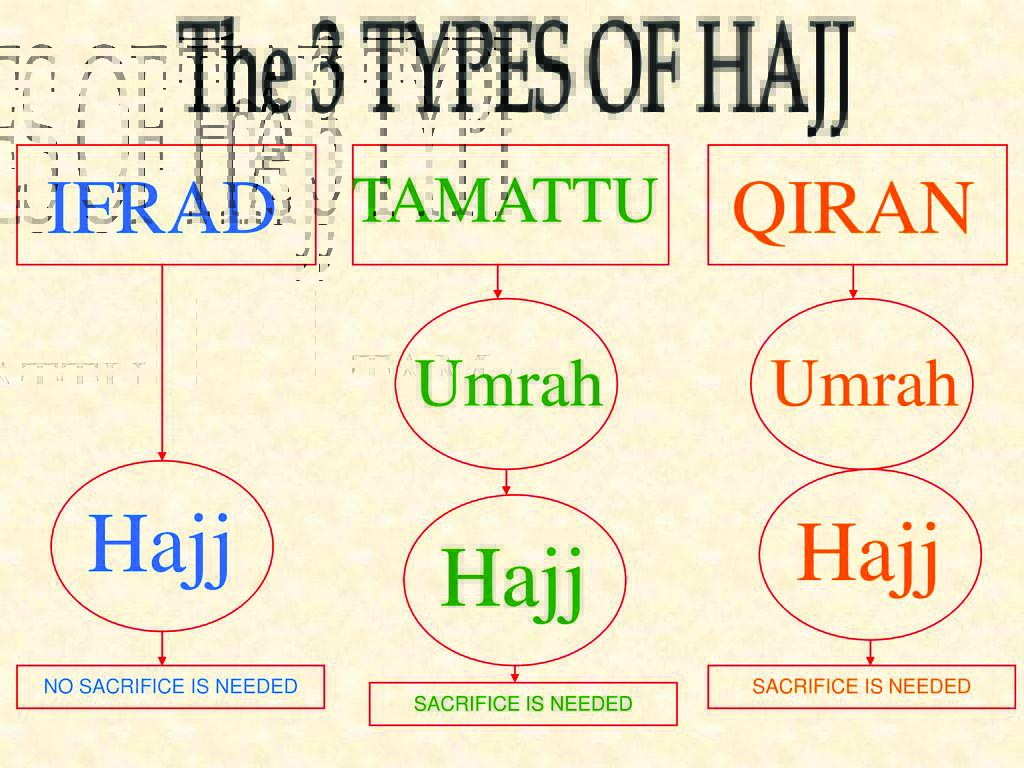
The three types of hajj are the Hajj al-Ifrad, Hajj al-Qiran, and Hajj al-Tamattu.
If you plan to perform Hajj, you can choose from three modes: Ifrad, Tamattu, or Qiran. Each mode provides pilgrims with options for conveniently performing Umrah and/or Hajj.
But how do you know which type of Hajj suits your needs?
Let’s take a closer look at the differences
between these three types of Hajj.
1: Hajj al-Ifrad (Hajj Only)
Hajj-ul-Ifrad is considered the simplest type of Hajj, and pilgrims performing it are called Mufrid. This type of Hajj is typically performed by residents of Makkah. It is also performed by those within the Miqat boundaries, such as people living in Jeddah.
Since it is not paired with Umrah, Hajj-ul-Ifrad is also known as the “isolated Hajj.” Pilgrims performing Hajj-ul-Ifrad cannot combine it with Umrah, as this Hajj is intended solely for Hajj rituals.
If a person performs Umrah during the Islamic months of Shawwal, Dhul Qadah, or Dhul al-Hijjah (the months of Hajj), they are no longer performing Hajj-ul-Ifrad. Instead, they must complete one of the other types of Hajj. To perform Hajj-ul-Ifrad, pilgrims enter Ihram intending to perform Hajj alone and declare this intention. Upon reaching Makkah, pilgrims complete Tawaf and Sa’i as part of their arrival ritual. They do not cut their hair to remain in the state of Ihram. A Mufrid stays in Ihram after stoning at Jamarat and may offer a sacrifice, although it is not obligatory.
2: Hajj al-Qiran (Umrah Merged with Hajj)
The literal meaning of Qiran is to combine two things, and this type of Hajj is known as accompanied Hajj. Hajj al-Qiran combines both Hajj and Umrah in a single visit. It is a concession from Allah SWT for those who live far from the sacred mosque, Masjid al-Haram. The Qarin, or the pilgrim performing this type of Hajj, may complete Umrah during the months of Shawal and Dhul Qadah. However, it is more commonly done within the first eight days of Dhul al-Hijjah. A Qarin must perform both Umrah and Hajj in the same Ihram, regardless of the time between the two rituals.
The pilgrim begins with Umrah, then proceeds to Hajj, wearing Ihram for both rituals. They start with performing Tawaf and Sa’i in Masjid al-Haram, which are the two key practices of Umrah. After completing Umrah, the pilgrim trims their hair but must not shave until after completing Hajj.
The obligations for Qarin are similar to those of Mufrid, with the exception that those performing Hajj al-Qiran must sacrifice an animal (Udhiya/Qurbani). Those performing Hajj al-Ifrad are not required to do so.
3: Hajj al-Tamattu (Umrah Followed with Hajj)
The final type of Hajj is Hajj al-Tamattu, which means to enjoy or benefit from a facility. Similar to Hajj al-Qiran, Hajj al-tamattu combines both Umrah and Hajj, but there is a key difference between Umrah and Hajj.
In Hajj al-Tamattu, after completing Umrah, the pilgrim, known as the Mutamatti, is allowed to exit the state of Ihram. They are not required to remain in the same Ihram for the entirety of the rituals.
The Mutamatti enters the state of Ihram to perform Umrah alone, exiting the state of Ihram after completing it. On the eighth of Dhul-Hijjah, as they proceed to Hajj, they enter a new state of Ihram.
This allows them relief from the restrictions of Ihram during the period between Umrah and Hajj. Hajj al-Tamattu is only available to those who live more than 48 miles from Makkah. Additionally, Umrah must be performed during the Hajj season.
Umrah is considered invalid if performed before Shawwal or during the days of Hajj. Additionally, the pilgrim performing Umrah as part of Hajj al-Tamattu is not permitted to leave without completing Hajj.
Like Hajj al-Qiran, the Mutamatti must offer an animal sacrifice during the pilgrimage. If they fail to do so, they must fast for the first ten days of Dhul al-Hijjah, excluding Eid al-Adha. Source: pakistansweethome.org.pk