













By Nafisa Siddiqui
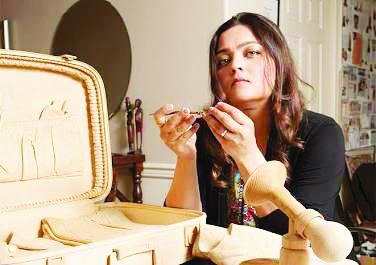
Let me introduce you to an extraordinary artist who has chosen wood as her primary medium of expression. Intriguing, isn’t it? The delicate, graceful woman with expressive eyes and an angelic face creates powerful and labor-intensive sculptures—proving that a woman can achieve anything when she sets her mind to it.
Humaira Abid is not just a brilliant artist; she is also a devoted mother and a deeply honest, compassionate, and inspiring human being.
Born and raised in Lahore, Pakistan, Humaira immigrated to the United States in 2008 and now lives and works in Seattle, WA. She earned her BFA in Sculpture and Miniature Painting from the National College of Arts, Lahore, in 2000. Her work has been exhibited in galleries and museums worldwide and has been reviewed by both local and international media. She was the recipient of the 2019 Artist Trust Arts Innovator Award, among many other prestigious honors and grants.
Humaira’s work has also been featured in books and print media. She’s participated in global residencies and symposia and has lectured extensively. Two documentary features focused on her work—produced by PBS (KCTS9) and Seattle Channel—were both nominated for Northwest Emmy Awards.
One of Abid’s most heart-wrenching works was inspired by the Taliban terrorist attack on the Army Public School in Peshawar, Pakistan. Hundreds of students and staff were murdered and injured in their own school and the nation was left shocked and traumatized along with the affected families. In her wooden sculptures, Humaira depicts the emotional significance and impact of this massacre by carving out children’s shoes and bags stained with their blood and includes swings that show how innocent the victims were. She also included a broom brushing away bloodied pacifiers, showing how throughout history incidents such as this are “cleaned up” by governments and media but leave families haunted. These works illustrate the deeper cruelty of this type of attack that steals dreams and futures and the failure of institutions to handle them.
What sets her apart is the way she transforms everyday objects and current events into deeply moving wooden sculptures. Her art speaks louder than a thousand-word article or an entire book. One of her recent exhibitions, centered on the Gaza war, has drawn significant attention. Each piece in this series tells the tragic story of innocent children lost to brutal conflict.
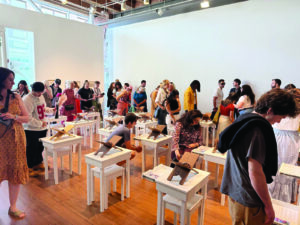
Represented by Greg Kucera Gallery in Seattle, her latest series, titled “The Shape of War”, was recently exhibited in a Seattle gallery. This powerful installation explores the devastating aftermath of war, focusing particularly on the loss of young lives and their unfulfilled dreams.
Each sculpture is accompanied by translated and transcribed stories of real children who lived—and died—through war. One particularly poignant piece features a collection of school desks. Instead of textbooks and pencils, the desks display prayer beads placed on a Rehal—symbolizing death, loss, and the prayers offered for those who have passed away.
Delicate carved flowers—Primrose and Petunia blossoms—sit atop the prayer beads. The Primrose, often the first flower to bloom in spring, symbolizes youth and innocence, while Petunias represent hope.
Inside each desk drawer is information about a child lost to war. These children were more than just names and ages in the headlines—they had dreams, families, and the potential to change the world. This installation is a tribute to them and a call to remember the countless beautiful lives that have been senselessly taken.