






















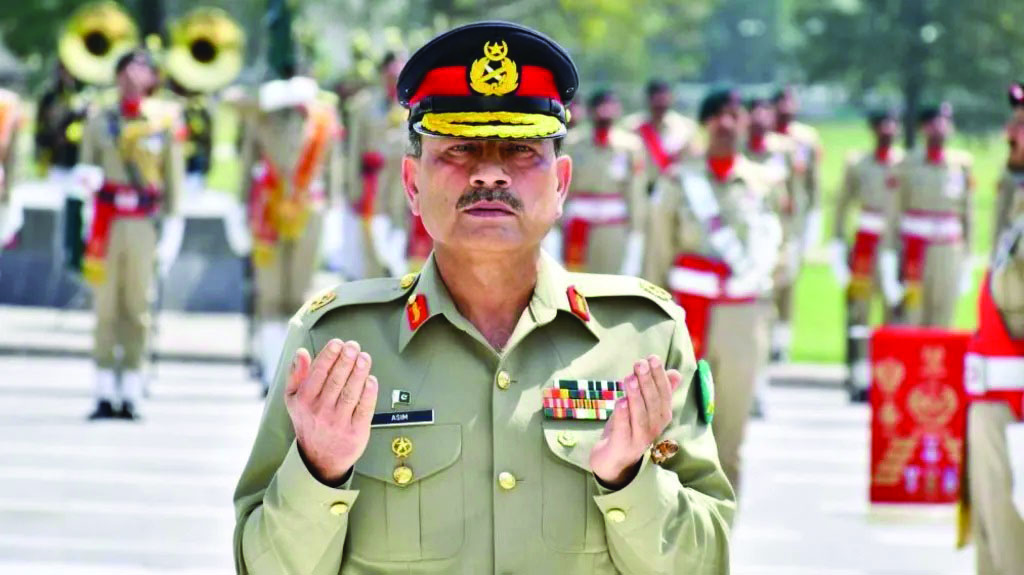
General Syed Asim Munir — Current Chief of Army Staff (COAS)
Full Name: General Syed Asim Munir Ahmad Shah
Service Branch: Pakistan Army (Frontier Force Regiment)
Commissioned: 1986 (17th Officers Training Course, Mangla)
* Career and Rise
Early Career
Commissioned into the Frontier Force Regiment.
* Served in key command, staff, and intelligence positions.
Known for discipline, piety, and professionalism.
ISI & MI Chief
Served as Director-General of Military Intelligence (DGMI).
Later appointed as Director-General of ISI (Inter-Services Intelligence) in October 2018 under PM Imran Khan’s government.
However, his ISI tenure was short (around 8 months) — reportedly due to tensions with Imran Khan over internal matters.
Corps Commander Gujranwala
Later became Corps Commander Gujranwala, an important field command.
Quartermaster General (GHQ)
Before becoming COAS, he was serving as Quartermaster General — a logistics and supply chain command role at GHQ.
* Becoming the Army Chief Date of Appointment:
November 29, 2022
(Reappointment notification might be on Nov 30, 2025)
Appointed and re appointment expected By: Prime Minister
Shehbaz Sharif (PML-N government)
Succeeded: General Qamar Javed Bajwa
He became Pakistan’s 17th Chief of Army Staff (COAS) — the highest active rank in the Pakistan Army.
* About the “Field Marshal” Rank
The rank of Field Marshal is above a General — but it is purely ceremonial and extremely rare in Pakistan.
Only one person in Pakistan’s history has ever been promoted to Field Marshal: Field Marshal Muhammad Ayub Khan (1959)
Since then, no other Pakistani general has been given that rank including Yahya Khan, Zia ul Haq, and Pervaiz Musharraf.
So, General Asim Munir is not a Field Marshal, who promoted like Ayub Khan.
He remains a four-star General (the standard rank for an Army Chief). Source: AI
Pakistan’s army has always been influential – now its chief has new powers.
By Caroline Davies
Pakistan correspondent, Islamabad
Pakistan’s parliament has voted to give army chief Field Marshal Asim Munir new powers and lifetime immunity from arrest and prosecution, a move that critics say paves the way towards autocracy.
The 27th constitutional amendment, which was signed into law on Thursday, will also make significant changes to the way the country’s top courts operate.
Those defending the changes say they provide clarity and administrative structure to the armed forces, while helping to ease a backlog in the courts.
Pakistan’s military has long played a prominent role in the nuclear-armed country’s politics – sometimes seizing power in coups, and, on other occasions, pulling levers behind the scenes.
Throughout its history, Pakistan has oscillated from more civilian autonomy to overt control under military leaders like General Pervez Musharraf and General Zia-ul-Haq. Analysts refer to the balance between civilian and military as hybrid rule.
Some see the amendment as a sign that the balance is shifting in the military’s favour.
“For me, this amendment is the latest indication, perhaps the strongest yet, that Pakistan is now experiencing not a hybrid system, but a post-hybrid system,” says Michael Kugelman, former director of the Wilson Center’s South Asia Institute in Washington.
“We’re essentially looking at a situation where the civil-military imbalance is about as imbalanced as it could possibly be.”
The latest amendment means that Munir, who has been army chief since November 2022, will now also oversee Pakistan’s navy and air force.
His field marshal title and uniform are for life and he will be given “responsibilities and duties” even after retirement determined by the president with the advice of the prime minister.
The expectation is that this will give him a prominent role in public life for as long as he is alive.
Supporters of the bill have argued it clarifies Pakistan’s military command structure.
Pakistan’s government-operated news agency, the Associated Press of Pakistan, cited Prime Minister Shehbaz Sharif as saying that the changes were part of a broader reform agenda to ensure Pakistan’s defence keeps pace with modern warfare requirements.
But others see it as ceding power to the military.
“There is no balance between the military and the civilians,” says Munizae Jahangir, journalist and co-chair of the Human Rights Commission of Pakistan.
“They have tilted again that power dynamic towards the military and empowered the military at a time when the military needed to be reined in.”
Source: bbc.com/news/articles