
















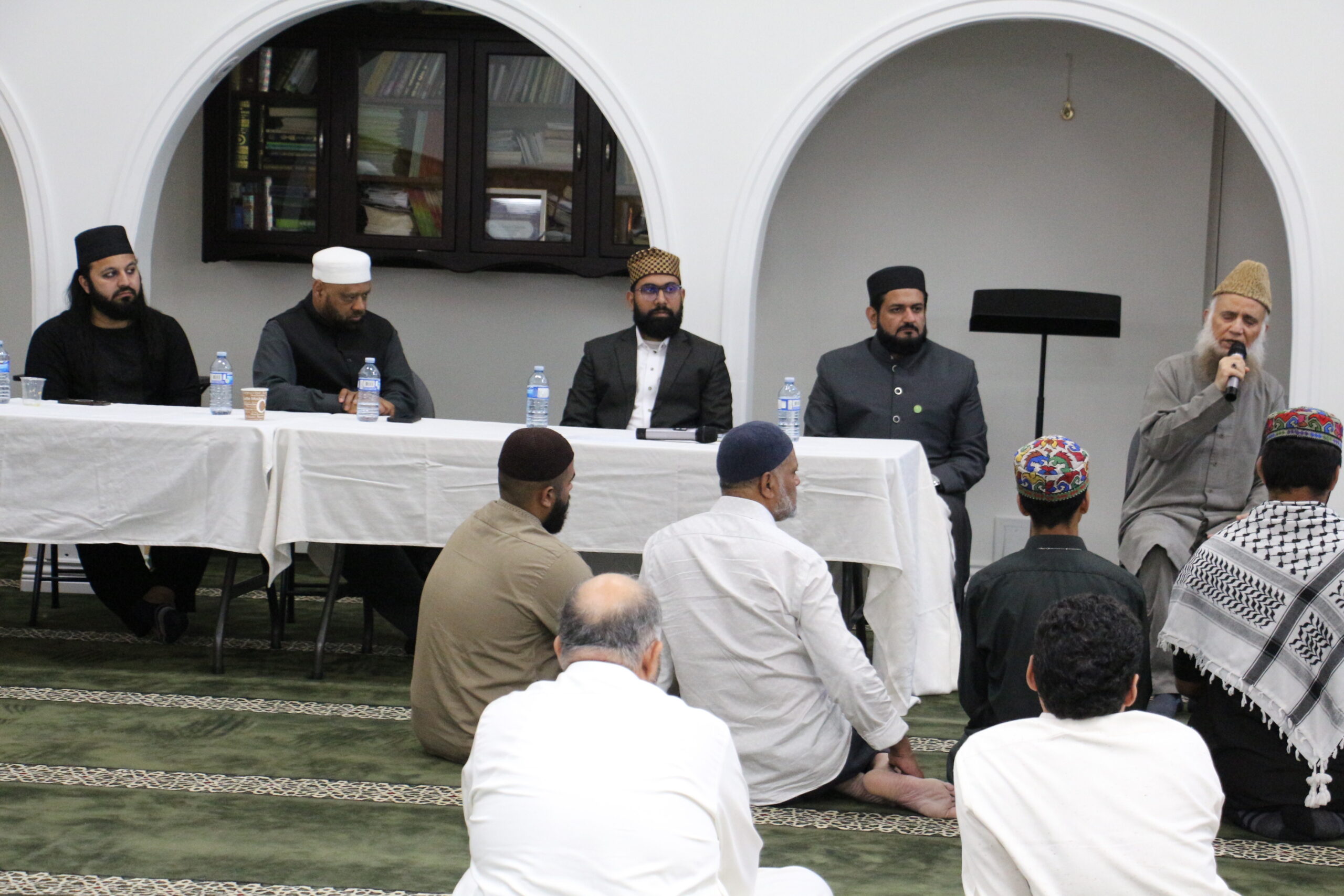
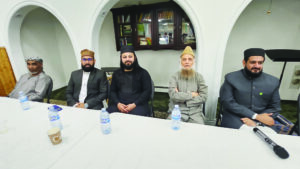
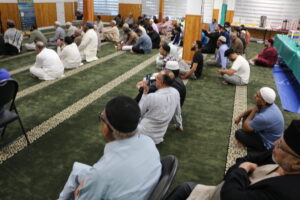
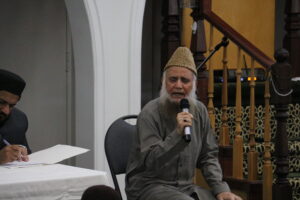
On July 13, 2025, the Shuhada-e-Karbala Conference was held at the Fiji Islamic Centre, jointly organized by Masjid Aulia Allah and the Fiji Islamic Centre.
The event featured Dr. Abbas Ali Raza as the keynote speaker, who traveled specially to attend and share insights on the sacrifices of the martyrs of Karbala. Adil Iqbal Soharwardhy, a renowned Naat reciter from Toronto, also joined the program and captivated the audience with his soulful recitations.
The program was hosted by Hafiz Osama Sarwar Khan, Imam of the Fiji Islamic Centre, who served as the Master of Ceremony.
The conference commenced with the recitation of the Holy Qur’an by Muhammad Saad Salis, followed by Naat recitations by Muhammad Saad Salis and Adil Iqbal Soharwardhy.
Renowned Naat Khawan Al-Haaj Fasihudeen Soharwardhy also graced the event with his presence and participation.
A significant highlight of the event was a speech on the Martyrs of Karbala (Shuhada-e-Karbala), by Dr. Ali Raza which deeply moved the audience. The conference was a powerful and emotional tribute to the legacy of Karbala, leaving the attendees spiritually uplifted and reflective.
The Prophet Muhammad (SAW) passed away when Imam Hussayn (AS) was around six or seven years old. Imam Hussayn (AS) gave his life in martyrdom at approximately the age of fifty.
The Prophet (SAW) held a deep and unique love for Imam Hussayn (AS), referring to him as his son and declaring, “Hussayn is a part of me, and I am a part of Hussayn.”
It is narrated that Imam Hussayn (AS) would walk in front of the Prophet (SAW)during prayer, and the Prophet would lovingly acknowledge him. At times, while in sujood (prostration), the Prophet (SAW) would prolong it because Hussayn (AS) was sitting on his shoulders. This was not merely affection—it was a reflection of spiritual intimacy and divine love.
The Prophet (SAW)declared, “Hassan and Hussayn are the leaders of the youth of Paradise.”
He also said: “Whoever loves Hussayn loves me. And whoever loves me is loved by Allah. And whoever Allah loves, He grants them Paradise.”
Despite the deep love and reverence the Prophet (SAW) had for his grandsons, some today speak harshly of Imam Ali (AS), their father. Yet the Prophet (SAW) himself praised and honored them publicly.
Critics claim that Imam Hussayn (AS) desired power or leadership—but his sacrifice proves otherwise. He did not seek a throne. He sought truth, justice, and the preservation of the Prophet’s message.
A hadith tells us:
The companion Abdullah ibn Amr was writing down everything the Prophet (SAW)said. Some Quraysh advised him to stop, saying the Prophet is only human and may speak in different moods. Abdullah asked the Prophet (SAW), who replied:
“Write everything, for by the One in whose hand is my soul, nothing comes from this mouth except truth—whether I am pleased or angry.”
The Prophet (SAW) said:
“Whoever loves my grandsons truly loves me. And on the Day of Judgment, that love will be your salvation.”
Imam Hussayn (AS) was also known for his compassion. One incident tells of a servant who accidentally spilled hot water on him and feared severe punishment. Realizing the servant was distraught, Imam Hussayn (AS) forgave him immediately, saying, “I forgive you—and I forgive you for eternity.”
It is narrated that the Prophet (SAW) had no shadow and that his sweat was fragrant. Imam Ali (AS) narrated that the Prophet (SAW) once said:
“Hassan and Hussayn are my two flowers in this world.”
The names of the Ahlul Bayt (AS) are said to hold healing. Those who call upon them with sincerity and love may find both spiritual and physical cure.
Imam Hussayn (AS) was not just a wali (saintly friend of God); he was also a martyr. And being a wali does not exempt one from hardship. Consider Prophet Ibrahim (AS): when he was thrown into the fire, Jibreel (AS) came and offered to save him. But Ibrahim asked, “Did Allah send you?” When Jibreel (AS) said he had permission to come but not to intervene, Ibrahim replied, “Then leave me. Allah knows my condition. Let whatever He wills happen.”
Imam Hussayn (AS) had this same submission. He gave everything—his family, his companions, his children—but never once questioned Allah. He did not complain of fear or exhaustion. He carried the bodies of his loved ones back to the tent himself and prayed over each of them: his brother Abbas (AS), his six-month-old son Ali Asghar (AS), and all 71 martyrs.
He was unwavering—just like Ibrahim (AS).
And yet today, many of us abandon faith over a single hardship. But the word “shah” (as in shaheed, martyr) comes from the root meaning “to witness” or “to calm a soul.”
Hussayn (AS) is our Badshah—our king—and our Shah—our soul’s peace.
Without love for Imam Hussayn (AS), there is no true faith, no religion, and no refined character.
By: Imam Hafiz Osama