








Advance polls will be open for 4 days over the long weekend
Four party leaders shared the stage for the final time Thursday night before Canadians head to the polls.
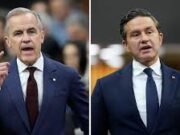
Liberal Leader Mark Carney, Conservative Leader Pierre Poilievre, Bloc Québécois Leader Yves-François Blanchet and NDP Leader Jagmeet Singh discussed numerous topics in the English leadership debate, including energy projects, the environment, public and national security as well as the cost of living. Thursday’s two-hour affair was the final debate before advance polls open this weekend.
Voting day itself is just over a week away. Here are six key moments and
exchanges from Thursday night. Others target Carney early and often
Carney’s Liberals have held a fairly steady lead in the polls since the election was called last month. Carney was the main target of the other party leaders as a result.
Poilievre, Blanchet and Singh all took a swipe at Carney within the first 10 minutes of the debate.
Poilievre led the way by repeating his main argument from the campaign: that the Liberals have weakened the economy and shouldn’t be trusted with another term.
Singh said Carney should have done more on EI before calling an election, while Blanchet accused him of not offering enough support to Quebec industries impacted by U.S. tariffs. The three leaders vying to unseat the Liberals did have exchanges with each other, but mostly tried to keep the focus on Carney.
About a quarter of the way through the debate, Singh accused Poilievre of wanting to give tax breaks to wealthy Canadians and businesses. Moderator Steve Paikin asked Poilievre to respond to Singh, but the Conservative leader used the time to again focus on Carney.
Later in the debate, each leader was given an option to pose a question to one of their opponents. Poilievre, Singh and Blanchet all chose Carney.
Carney was the last to choose and joked, “I’m going to ask myself a question,” before posing one to Poilievre.
Political math
Singh and Poilievre ran a replay from the French debate when it came to housing. The NDP leader attacked his Conservative opponent’s record, claiming that Poilievre only had six homes built when he briefly managed the housing file in Stephen Harper’s cabinet.
Poilievre shot back, accusing Singh of not “being very good with math,” and claimed 200,000 homes were built when he was minister. “You can count up to six, which is great,” Singh said, pushing back on Poilievre’s math quip.
But neither leader is telling the full story. Singh’s claim that Poilievre only built six homes as housing minister refers only to non-profit community housing units built exclusively by the government in 2015. When you include non-profit housing built by others with federal government help, it’s more like 3,742 houses.
But it’s hard for Poilievre to take responsibility for the 200,000 homes he says were built when he was minister. In the 2015-16 fiscal year, 194,461 homes were built in Canada in total, including by private developers.
Carney jumped in at the end of the exchange to say Poilievre’s number was a “misunderstanding of the housing market.”
Poilievre vs. Carney (and Trudeau)
Part of Poilievre’s strategy during the campaign is to tie Carney to former prime minister Justin Trudeau, which he continued to do Thursday night.
Poilievre referred to Carney as Trudeau’s “economic adviser.” Carney did offer advice to the last government during the COVID-19 pandemic and at the end of last year on a part-time basis.
But the Liberal leader tried to counter by saying he is a different person with different policies.
“It may be difficult, Mr. Poilievre, you spent years running against Justin Trudeau and the carbon tax — they’re both gone,” Carney said early in the debate. Poilievre shot back saying Carney was doing a “good impression” of Trudeau….
Source: cbc.ca/news/politics
Wednesday, May 13, 2026