


















Source: Oxford University
Muslims believe that Muhammad PBUH (ca. 570 – 632 ) was God’s Messenger sent to proclaim in Arabic the same revelation that had been proclaimed by earlier Jewish and Christian prophets, first to the Arabs and then to all people. The Quran provides some historical information about Muhammad’s life, but fuller accounts are available in sirah (traditional biographies), hadith (reports of Muhammad’s sayings and deeds), and general histories.
Muhammad PBUH grew up as an orphan in the tribe of Hashim under the guardianship of his uncle, Abu Talib . Details of his early life are not known with certainty. When he was twenty-five Muhammad was hired by a wealthy widow named Khadijah to oversee her caravan of goods to Syria. Muhammad later married her. They had four daughters who grew to adulthood and at least three sons, all of whom died in infancy. During her lifetime Khadijah was Muhammad’s only wife. After her death, he married a widow named Sawdah . Khadijah and Sawdah were his only wives prior to the hijrah. Once in Medina, Muhammad contracted other marriages based on political alliances and his responsibilities as the head of the Muslim community.
Muhammad PBUH received his first revelation at about the age of forty when the angel Gabriel appeared and recited surah 96 to him. Accounts of miraculous foretelling of Muhammad’s future prophethood in the sirah and hadith literature include recognition of Muhammad’s prophetic status by Christian monks and a light shining from Muhammad’s face and that of his mother during her pregnancy. Other miraculous accounts include Muhammad’s Night Journey, or isra, from Mecca to the Temple Mount in Jerusalem and his ascension to heaven, or miraj.
The Quran does not specifically refer to Muhammad’s public ministry in Mecca, but the biographical sources record the emigration of Muhammad’s followers to Abyssinia (modern-day Ethiopia), the boycott of Muhammad’s clan of Hashim, the deaths of his wife Khadijah and his uncle and protector, Abu Talib, the loss of his clan protection, his visit to al-Taif for refuge, and the hijrah to Medina. The Quran portrays Muhammad as fully human with no supernatural powers. His humanness is most apparent in the passages where he is told to be steadfast and patient in times of persecution, disappointment, or grief. Although he won many victories over the Meccans and succeeded in converting many of the tribes of Hejaz, the Quran records that Muhammad agonized over those who did not believe and remained humble, shy, and sincere. He constantly sought forgiveness for his own sins.
The Quran, sirah, and reports of Muhammad’s military expeditions provide extensive information about the Medinan period. His victories over the larger forces of the Meccans were interpreted as signs of God’s favor. By 627 Muhammad was in complete control of Medina, and Bedouin tribes in the surrounding area were making alliances with him and becoming Muslims. In the spring of 628 Muhammad negotiated a treaty with the Meccans for permission to perform the pilgrimage, or hajj, the following year, along with a ten-year truce. He led the first Muslim pilgrimage to Mecca in the spring of 629 . When the truce was broken a year later, the leaders of Mecca agreed to surrender the city peacefully to Muhammad PBUH. As a result, Muhammad PBUH was in command of all of west-central Arabia by 630 . In 631 envoys from all over Arabia came to him to surrender. Muhammad PBUH regarded the resulting treaties as an acceptance of Islam. In 632 he led the largest number of Muslim pilgrims ever assembled during his lifetime on his “Farewell Pilgimage.” On the return trip to Medina, Muhammad PBUH contracted a fatal illness. He died in June 632 , at about the age of sixty.
Muhammad PBUH served as administrator, legislator, judge, and commander-in-chief as well as teacher, preacher, and prayer leader of the Muslim community. For the scholars of Islamic law he is the legislator-jurist who defined ritual observance; for the mystic he is the ideal seeker of spiritual perfection; for the philosopher and statesman he is the role model of both a conqueror and a just ruler; for ordinary Muslims, he is a model of God’s grace and salvation.
Source: islamicity.org
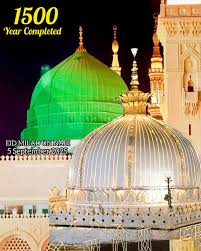
Question 92459 Why some people accept and some un accept the celebration of the prophet (saw )?
What is your opinion?
Praise be to Allah.
Answer:
There is nothing in the Quraan to say that we should celebrate the Mawlid or birthday of the Prophet (peace and blessings of Allaah be upon him). The Prophet himself (peace and blessings of Allaah be upon him) did not do this or command anyone to do it, either during his lifetime or after his death. Indeed, he told them not to exaggerate about him as the Christians had exaggerated about Jesus (upon whom be peace). He said: Do not exaggerate about me as the Christians exaggerated about the son of Maryam. I am only a slave, so say, The slave of Allaah and His Messenger.
(Reported by al-Bukhaari). What has been reported is that the Prophet (peace and blessings of Allaah be upon him) made the day of his birth a day of worship, which is different to celebration. He was asked about fasting on Mondays, and he said: That is the day on which I was born and the day on which I was entrusted with the Mission or when I was first given Revelation. (Reported by Muslim, al-Nisaai and Abu Dawood).
Moreover, we know that the Sahaabah (may Allaah be pleased with them) were the people who loved the Prophet most. Was it reported that Abu Bakr, who was the closest of people to him and the one who loved him the most, celebrated the birthday of the Prophet (peace and blessings of Allaah be upon him)? Was it reported that Umar, who ruled for twelve years, or Uthmaan, did this? Was it reported that Ali, his relative and foster son, did this? Was it reported that any of the Sahaabah did this? No, by Allaah! Is it because they were not aware of its importance, or did they not truly love the Prophet (peace and blessings of Allaah be upon him)? No one would say such a thing except one who has gone astray and is leading others astray.
Did any of the imaams Abu Haneefah, Maalik, al-Shaafii, Ahmad, al-Hasan al-Basri, Ibn Seereen do this or command others to do it or say that it was good? By Allaah, no! It was not even mentioned during the first and best three centuries. The Prophet (peace and blessings of Allaah be upon him) said in a saheeh hadeeth: The best of mankind are my generation (or my century), then those who come after them, then those who come after them. Then there will come a people who will not care if their testimony comes before their oath or vice versa (i.e., they will not take such matter seriously).
(Reported by al-Bukhaari, Muslim and al-Tirmidhi). The celebration of the Prophets birthday appeared many centuries later, when many of the features of true religion had vanished and bidah had become widespread.
Thus this celebration became a sign of ones love for the Prophet (peace and blessings of Allaah be upon him)? But can it be possible that the Sahaabah, the imaams and the people of the best three centuries were unaware of it, and it was only those who came later who were aware of its importance?! What the Quraan tells us is that love of the Prophet (peace and blessings of Allaah be upon him) is demonstrated by following the guidance he brought. Allaah says (interpretation of the meaning):
Say (O Muhammad): If you (really) love
Allaah, then follow me, Allah will love you and forgive you your sins. And Allaah is Oft-
Forgiving, Most Merciful.
Say: Obey Allaah and the Messenger. But if they turn away, then Allaah does not like the disbelievers. [Aal Imraan 3:31-32]
The first aayah explains that love is just a claim, but the proof of sincerity is following what the Prophet (peace and blessings of Allaah be upon him) brought. The second aayah reaffirms the importance and necessity of obeying Allaah and His Messenger. Hence Allaah ended the aayah with a very stern warning in which those who refuse to obey are described as kaafirs, and Allah does not love the disbelievers. We ask Allaah to keep us safe from that. The Prophet (peace and blessings of Allaah be upon him) told us of the danger of not obeying him, and the danger of adding to what he brought. The celebration of Mawlid or his birthday is indeed an addition to what he brought as all the scholars agree. He said: The best of speech is the Book of Allaah, and the best of guidance is the guidance of Muhammad. The most evil of things are those which are newly-invented (in religion), and every innovation is a going astray.
(Reported by Muslim and al-Nisaai).
We ask Allaah to protect us from bidah and to bless us by helping us to follow. Allaah knows best. May Allaah bless our Prophet Muhammad(SAW).(Source: islamicity.org/qa)

