














Nuclear scientists say risk of country building a bomb has only grown .
By Evan Dyer · CBC News
Nuclear weapons experts are warning that the U.S.-Israeli war on Iran, ostensibly launched to prevent the country from
obtaining nuclear weapons, may have instead made an Iranian bomb more likely.
That is because prior to the war, Iran was held back not by technical constraints but diplomatic considerations, say two nuclear weapons experts who were involved in past U.S. efforts to sanction and contain the country.
Those diplomatic calculations have changed.
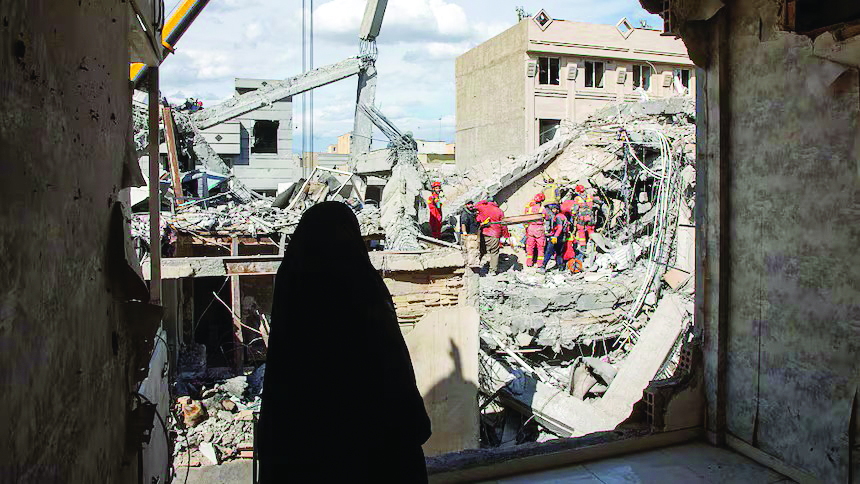
Outcomes that Iran tried for years to avoid bombing of its cities, assassination of its senior leadership, the destruction of its air force and navy — have now occurred.
The scientists say that the focus on preventing Iran from enriching uranium to what’s often termed “weapons grade” has obscured the fact that Iran does not have to attain the levels of enrichment seen in sophisticated nuclear weapons produced by superpowers in order to make a fearsome bomb.
Physicist Steve Fetter, a member of the U.S. National Academy of Sciences Committee on International Security and Arms Control, says Iran’s estimated 440 kilograms of 60 per cent enriched material “is already directly usable to produce nuclear weapons.”
Fetter headed the national security and international affairs division of the White House Office of Science under U.S. President Barack Obama and was involved in the nuclear deal signed with Iran — torn up by President Donald Trump in his first term.
‘Breakout time’ likely short “You can probably make a weapon — a rather large and crude one — at 60 per cent enrichment,” agreed plasma physicist Tara Drozdenko, who has worked on nuclear weapons issues for the U.S. Navy and State Department and served under the administrations of Obama and George W. Bush.
“It’s just going to be very bulky and big, because you’d need more uranium to get to a sustained chain reaction.”
Drozdenko has extensive experience dealing with proliferation issues. She headed the Country/Regime Sanctions Unit at the U.S. Department of Treasury from 2008 to 2012, where she managed more than 20 of the U.S. government’s economic sanctions programs, including on Iran and North Korea.
She also represented the United States on NATO’s Senior Group on Proliferation.
Drozdenko says Iran chose to stop its enrichment at 60 per cent for political, rather than technical, reasons.
Source: cbc.ca/news/politics