


















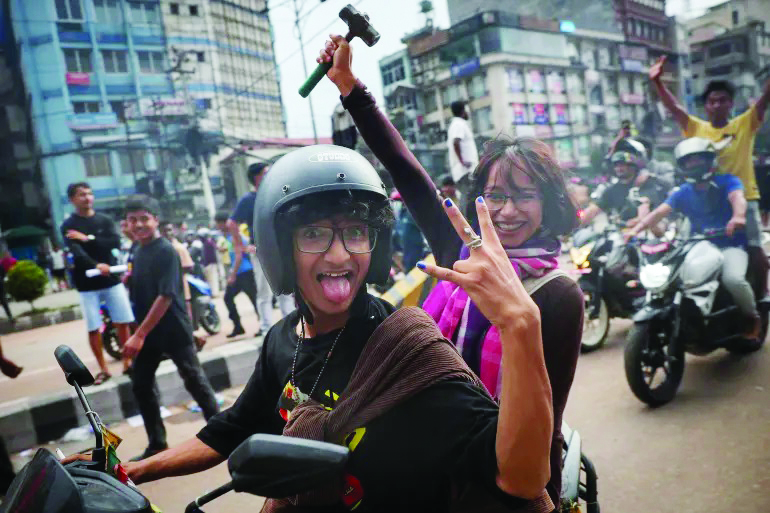
The contexts and triggers were different, but analysts say there’s a common thread tying South Asia’s youth revolts — and that protesters have learned from each other..
New Delhi, India — The rattle of iron gates sounded like drumbeats as the crowd surged forward. A sea of bodies stormed through the barricades, which had stood as sentinels of power barely hours ago.
The hallways of the house of the country’s leader echoed with the thunder of muddy footsteps. Some smashed windows and artefacts, others picked up luxury bedsheets or shoes. The building and its plush interiors had been symbols of crushing authority, impenetrable and out of reach for the country’s teeming millions. Now, however, they briefly belonged to the people.
This was Nepal last week. It was also Sri Lanka in 2022, and Bangladesh in 2024.
As Nepal, a country of 30 million people sandwiched between India and China, now plots its future in ways alien to traditional electoral democracies, the spate of youth-led protest movements that have toppled governments one after the other in South Asia has also sparked a broader question: Is the world’s most densely populated region Ground Zero for Gen Z revolutions?
“It’s certainly very striking. There’s this kind of new politics of instability,” said Paul Staniland, an associate professor of political science at the University of Chicago, whose research focuses on political violence and international security in South Asia.
On Thursday, some 10,000 Nepali youth, including many in the diaspora, voted for an interim prime minister not through physical or electoral ballots, but through an online poll on Discord, a platform primarily used by gamers. Nepal, where three days of protests against corruption and nepotism turned violent, with a crackdown by security forces leading to the death of more than 70 people, has announced new elections in March. But the protests, which forced Prime Minister KP Sharma Oli to resign days after he had mocked the Gen Z origins of the agitators, have already shown that in nation after nation in South Asia, increasingly frustrated young people are grabbing power and declaring themselves boss when they feel betrayed by political systems out of tune with their demands.
This is a dramatic shift for South Asia, a region that has long been home to major political protests, but rarely ones where regimes are overthrown, Staniland told Al Jazeera. “This is a very different kind of orientation from a world that has military coups, or the main form of political conflict is something else,” he added, referring to the ways political crises in the region have previously often played out.
Each of the protest movements – in Sri Lanka, Bangladesh and Nepal – was rooted in specific histories and was triggered by events unique to that country. Yet, analysts say, there is a common thread that runs through the rage that exploded in these countries: a generation that is refusing to live with broken promises, and the factors driving them. These movements, experts say, also appear to be learning from each other.
From Colombo to Dhaka to Kathmandu: The backdrop
The Gen-Z protests in Kathmandu kicked off after the government banned social media platforms, citing misuse and the failure of the platforms to register with regulators. But the grievances ran much deeper: inequality, corruption and nepotism were the major triggers for young people in a country where remittances sent home by Nepalis abroad represent a third of the nation’s economy. Thousands of teenagers hit the streets, many still in school uniforms. More than 70 people were shot dead, and hundreds more were injured.
But the violence unleashed on protesters by security forces only aggravated the crisis. Some demonstrators torched the parliament, while others set the houses of other political parties, some leaders, and even Nepal’s largest media house on fire. Protesters also broke into Oli’s house, ransacking it.
Source: aljazeera.com/news

