
















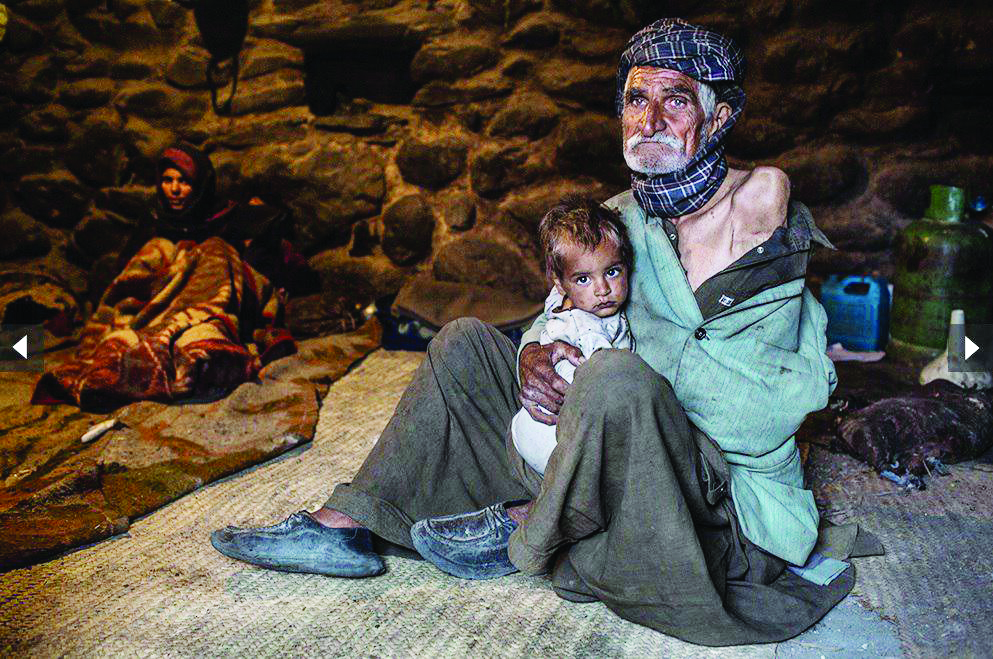



Chief Justice of Pakistan Mian Saqib Nisar on Wednesday termed unbridled population growth as the “most disastrous issue” for Pakistan, and regretted that the “menace” was not given any attention in the past 60 years. He made the remarks while addressing a symposium in the capital on the alarming population growth in Pakistan.
“Our water reserves and resources are depleting, but our mouths [to feed] are increasing,” he said while addressing the event that was attended by several high-profile personalities, including judges and Prime Minister Imran Khan. CJP Nisar called on the prime minister to probe why no dam had been built in Pakistan in the past 40 years and why the country was facing such an “alarming” situation.“Today we have no water management in Pakistan. Water is life, without water we cannot conceive a life,” he said.
The top judge said that the apex court had created a task force which presented its recommendations after holding a few sessions but added that “that was the extent of their power”. ”The judiciary does not have any mechanism to act on these recommendations,” he said. “The only person who can get any implementation done is the prime minister,” he said. He said the Supreme Court has played its part in amplifying and understanding human rights and now it was the Executive’s job to take them forward.
Justice Nisar said the burden on the judicial system did not go back to just the past five to seven years but it was centuries old.
“The tools have to be given to us by the parliament,” he said, regretting that so much time had passed but laws had not been updated.“Perhaps the time has come to stop boycotting the parliament and sit in the parliament and [start doing] our actual duty,” he said. CJP Nisar said models used by other countries to restrain their population growth were before the country and that they just needed to be implemented and awareness needed to be created. “I am hopeful that with good intentions, we will reach our dream in a few years,” the top judge said.
Rapidly growing population in Pakistan

The demographics are the key to promoting economic development and security in Pakistan. It also prioritises family planning — particularly in an effort to promote birth spacing — as the best strategy for achieving ambitious population targets (2.1 births per woman in 2025). In many ways, the story of Pakistan is one of a failure of family planning. Although the Family Planning Association of Pakistan was set up as early as 1952, we have seen a five-fold increase in our population between 1951 and 2009, from 34 million to 171 million. Pakistan will have to reduce its current population growth rate to half in the next 30 years to achieve the status of a high middle-income country, as the current pace of increase in population is a barrier to becoming a prosperous nation. Pakistan’s latest estimated population is 207,774,520 (excluding the regions of Azad Jammu and Kashmir and Gilgit-Baltistan). This makes Pakistan the world’s fifth-most-populous country, just behind Indonesia and slightly ahead of Brazil. Including Azad Kashmir, the population would be 211.819 million. Gilgit Baltistan region has an additional estimated population of 1.8 million. During 1950–2011, Pakistan’s urban population expanded over sevenfold, while the total population increased by over fourfold. In the past, the country’s population had a relatively high growth rate that has been changed by moderate birth rates. Between 1998-2017, the average population growth rate stood at 2.40%.Dramatic social changes have led to rapid urbanization and the emergence of megacities. During 1990–2003, Pakistan sustained its historical lead as the second-most urbanized nation in South Asia with city dwellers making up 36% of its population. Furthermore, 50% of Pakistanis now reside in towns of 5,000 people or more. Pakistan has a multicultural and multi-ethnic society and hosts one of the largest refugee populations in the world as well as a young population. Population growth in Pakistan has continued to increase. Many factors are cited that contribute to the increasing rate: 1) absence of a coherent approach to overcome the social and cultural constraints to the use of family planning; 2) ineffective information, education and communication campaign; 3) frequent changes in the organizational set up of the program; 4) inefficient management; and 5) lack of political commitment to family planning. However, rising trend in contraceptive use to nearly 18% in 1994-95 and to about 24% in 1996-97 indicated positive response of Pakistani partners to the adoption of family planning. Still, the impact of the program is low since only one-fifth of women in Pakistan use contraceptives. In view of all these, the government set strategies that focus more on quality of service and accessibility of family planning centers. There is a need to improve the population planning efforts and reduce the fertility rate in order to cut down population pressures on the country’s physical and capital resources.
On Wednesday December 5, Chief Justice of Pakistan Mian Saqib Nisar termed unbridled population growth as the “most disastrous issue” for Pakistan, and regretted that the “menace” was not given any attention in the past 60 years.He made the remarks while addressing a symposium in the capital on the alarming population growth in Pakistan. Addressing CJP Nisar, the premier said that the steps that the top judge had taken should have been taken by democratic governments instead.”The democratic governments unfortunately only used to think about five years,” he said, adding that nothing could be accomplished in that time span for major issues.”We are in these problems because of a short-term thinking,” Prime Minister Khan regretted.The premier recalled the family planning campaigns shown on television in the 1960s, saying those were very “effective”. He said that people were under the impression that (formerly) East Pakistan had been a burden on the country’s population, but today Bangladesh had gotten ahead of Pakistan because of their long-term thinking.”As the population continues to grow, our food security will be affected,” he cautioned.Prime Minister Khan thanked the CJP for raising the matter of population growth which he called a very “serious issue”. He said the government has formed task forces to address population growth, adding that he was glad that all provincial chief ministers were on board for the initiative. Khan noted that the delivery system of contraceptives in the country was an issue but what was actually needed was an ambition to resolve the problem.”There is a big role for the ulema,” he said, citing examples of Iran and Bangladesh where population control campaigns were done from mosques. The premier said Pakistan too needed to involve its mosques in the campaign. Renowned religious scholar Maulana Tariq Jameel said Imran Khan is the first prime minister who presented the concept of state of Madinah. He said poverty and social pressures are important causes of population growth. Maulana Tariq Jameel said the issue of population control needs to be seriously taken.Here are some facts about Pakistan Population
•The current population of Pakistan is 202,395,872 as of Wednesday, December 5, 2018, based on the latest United Nations estimates.
•Pakistan population is equivalent to 2.63% of the total world population.
•Pakistan ranks number 6 in the list of countries (and dependencies) by population.
•The population density in Pakistan is 260 per Km2 (675 people per mi2).
•The total land area is 770,880 Km2 (297,638 sq. miles)
•39.5 % of the population is urban (79,279,647 people in 2018)
•The median age in Pakistan is 22.7 years.
