





Pakistan population is equivalent to 3.10% of the total world population. Pakistan ranks number 5 in the list of countries (and dependencies) by population. The population density in Pakistan is 331 per Km² (857 people per mi²).
The total land area is 770,880 Km² (297,638 sqm. 255,622,00 (Aug, 6, 2025
Source: worldometers.info/world-population/pakistan-population
 Federal government of Pakistan
Asif Ali Zardari President
Shehbaz Sharif Prime Minister
Yusuf Raza Gilani Chairman of the Senate
Ayaz Sadiq Speaker of the National Assembly
Yahya Afridi Chief Justice of Pakistan
Sikandar Sultan Raja Chief Election Commissioner of Pakistan
Provincial government,
Chief Ministers
Balochistan: PPP
Sarfraz Bugti (from 2 March 2024)
Khyber Pakhtunkhwa: PTI
Ali Amin Gandapur (from 2 March 2024)
Punjab: PML(N)
Maryam Nawaz (from 26 February 2024)
Sindh: PPP
Murad Ali Shah (from 27 February 2024)
State government:
Gilgit-Baltistan: Prime Minister PTI
Gulbar Khan (from 13 July 2023):
Azad Kashmir: Prime Minister PTI
Chaudhry Anwarul Haq (from 20 April 2023)
 Geography
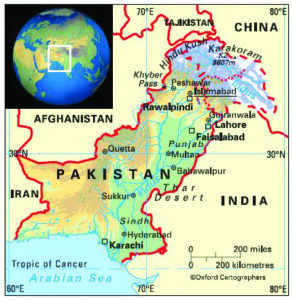
Pakistan is located in the southern part of Asia and borders Afghanistan and Iran to the west, China to the north and India to the east. The country covers an area of 796,100 square kilometers and has a population of 247.50 million people. The southern coastal strip on the Arabian Gulf is around 1,046 km long.
The north of the country lies partly in the mountain ranges of the Himalayas, Karakoram and Hindu Kush. With the 8,611 meter high K2, it is home to the second highest mountain peak in the world. A total of 5 of the 14 eight-thousanders are located in Pakistan or on Pakistani borders. The Baluchistan Plateau extends to the west, while the Thar Desert borders India to the southeast. The Indus, one of the longest rivers in the world, runs through the country from north to south. It forms the fertile Indus Valley, which is an important agricultural area.
The population density is 310.9 inhabitants per square kilometer, with a relatively low urbanization rate of just 37%. The largest cities are Karachi and Lahore. With only 1 million inhabitants (2 million in the metropolitan region), the capital Islamabad is only the tenth largest city in the country.
Border conflicts
Pakistan’s borders, and therefore the exact area and population of the country, have been the subject of debate for years. The current border demarcations are not mutually agreed. The border between Pakistan and India is one of the most contested and militarized borders in the world. The main point of conflict is the Kashmir region, which both countries claim in full but only partially control. Since the partition of British India in 1947, Pakistan and India have fought several wars over this area. The borders shown on today’s maps are based on the so-called Redcliffe Line, which was drawn in 1947 when British India was partitioned.
On the border with Afghanistan, there is also a long-standing dispute over the Durand Line, which was drawn by the British in 1893. Afghanistan does not recognize this border, which leads to tensions and occasional military clashes. In addition, cross-border movements by Taliban fighters destabilize the region.
Economy
According to the definition from the International Monetary Fund (IMF), Pakistan is a developing country because of its lower economic performance.
With an average annual income of 1,460 USD Pakistan is one of the lower middle-income countries.
Pakistan is considered one of the most
dangerous countries worldwide.
GDP: 337.89 bn $
 Languages
Official languages: English, Urdu
Statistics of Pakistan in Urdu
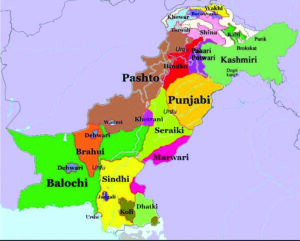
In Pakistan, Urdu is the national language and is widely spoken and understood, but it’s the first language of only about 9.25% of the population according to the 2023 census. While Urdu serves as a symbol of national unity, Punjabi is the most commonly spoken first language, followed by Pashto and Sindhi. The Pakistan Bureau of Statistics (PBS) is the federal agency responsible for collecting and disseminating statistical information about Pakistan according to Wikipedia
Mother tongue Distribution
Punjabi 48.0 %, English 46.0 %
Pashto 13.1 %, Sindhi 11.8 %
Saraiki 9.8 %, Urdu 7.6 %
Balochi 3.0 %, Hindko 2.4 %
Brahui 1.2 %, Gujarati 1.2 %
Many Pakistanis are growing up bilingual, with English becoming increasingly prevalent.
Religions
State religion: Sunni Islam
Religion Distribution
Sunni 80.0%, Shia 15.0%, Christs 1.6%
Hinduists 2.0%, others 1.4%
Land use
5% Urban areas: 35,872 km²
47% Agricultural areas: 374,406 km²
5% Forest: 38,452 km²
3% Water areas: 25,220 km²
40% Others: 322,151 km² more…..
Transport
Roadways: 263,775 km, Railways:11,881 km
Reg. vehicles: 30,000,000, Airports: 34
Source: worlddata.info/asia/pakistan/index.php