




















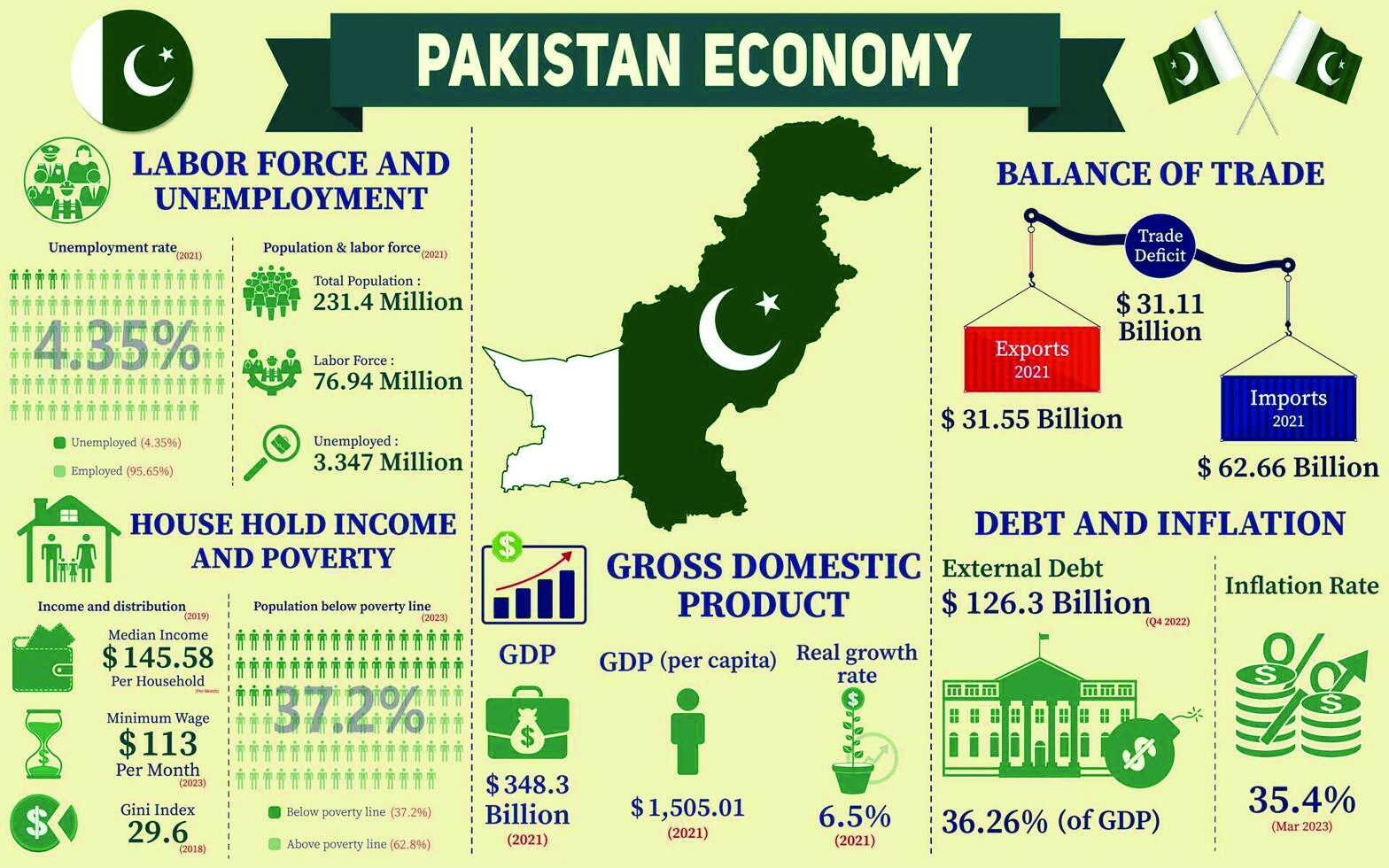
Pakistan experienced an economic crisis as part of the 2022 political unrest. It caused severe economic challenges for months, causing food, gas and oil prices to rise. As of 1 April 2025, Pakistan’s inflation rate was recorded at 0.7%, the lowest in 30 years.
The Russian invasion of Ukraine has caused fuel prices to rise worldwide. Excessive external borrowing by the country over the years raised the spectre of default, causing the currency to fall and making imports more expensive in relative terms. By June 2022, inflation was at an all-time high, along with rising food prices.[
Poor governance and low productivity per capita in comparison with other low to middle-income developing countries have contributed to a balance of payment crisis, where the country is unable to earn enough foreign exchange to fund the imports that it consumes.[5] Pakistan’s economic crisis served as the biggest crisis since its independence.[
As of 2025, the Pakistani economy is showing signs of gradual macroeconomic recovery, in June 2025 Pakistan led emerging markets to become the most improved in sovereign credit risk, seeing a 12% decline in default risk. On 1 March 2025, it was reported that the YoY headline inflation slowed to 1.5%, the lowest since 10 years as a result of a high base effect, declining global commodity and energy prices, a stable exchange rate, and a tight monetary policy.
People also ask
Source: en.wikipedia.org/wiki/Pakistani
What is the condition of Pakistan now?
In 2022, Pakistan experienced a trifecta of challenges, as political unrest, an economic crisis, and destructive floods gripped the nation. Economically, the country is grappling with severe inflation, a declining currency, and critically low foreign reserves, posing significant concerns for its financial stability.
Pakistan’s economy is currently experiencing a period of recovery and stabilization, with a provisional GDP growth rate of 2.68% for FY 2024-25. The size of the economy is estimated at US$411.0 billion, with a per capita income of US$1824.0. Inflation has significantly decreased, with national headline CPI averaging 4.7% during July-April FY2025, compared to 26.0% in the same period last year. However, challenges remain, including external debt and a fluctuating rupee, which contribute to economic vulnerabilities.
Key Economic Indicators:
GDP Growth: 2.68% (prov, FY 2024-25).
Per Capita Income: US$1824.0 FY 2024-25).
Inflation: National headline CPI at 4.7% (July-April FY2025), significantly lower than the previous year.
Investment: 13.14% of GDP (FY2024), lower than the previous year due to macroeconomic policies and political uncertainty, according to the Finance Division.
Savings: 13.0% of GDP (FY2024), slightly lower than the previous year, according to the Finance Division.
Agriculture: Estimated 6.25% growth in FY2024, driven by significant growth in key crops.
Industry: Positive growth of 1.21% in FY2024, with manufacturing and construction contributing significantly, according to the Finance Division.
Services: Largest sector in GDP, with a 57.7% share, and moderate growth of 1.21%, according to the Finance Division.
Other Important Factors:
Agriculture’s Role:
Agriculture remains a vital sector, contributing significantly to GDP, employment, and foreign exchange earnings.
External Debt:
Pakistan faces challenges related to external debt and debt servicing.
Rupee Fluctuations:
The rupee’s depreciation can impact the economy and contribute to inflationary pressures.
Inflation Control:
The government has implemented measures to mitigate inflation and stabilize prices of essential goods.
Quarterly National Accounts:
The introduction of Quarterly National Accounts (QNA) by the Pakistan Bureau of Statistics is a significant development in macroeconomic statistics, according to the World Bank. Source: google.com/search
Pakistan ranks among world’s weakest passports in 2025 index
Pakistan lags behind regional peers in global mobility as UAE breaks into top 10
By Ashfaq Ahmed, Senior Assistant Editor
Dubai: Pakistan’s passport has been ranked the fourth weakest in the world, placing 96th in the 2025 Henley Passport Index, alongside Somalia and Yemen.
Pakistani citizens enjoy visa-free or visa-on-arrival access to 32 destinations only, underscoring the country’s limited global mobility. Published by the UK-based consultancy Henley & Partners, the annual index ranks 199 passports based on the number of destinations their holders can enter without a prior visa. The index uses data from the International Air Transport Association (IATA) and is widely considered the most authoritative measure of passport strength.
Pakistan’s ranking remains near the bottom, ahead of only Syria, Iraq, and Afghanistan, the latter retaining its position as the world’s weakest passport with access to just 25 countries.
The Pakistan government officials, including Interior Minister Mohsin Naqvi, recently acknowledged business community concerns and pledged to expand visa access through more international agreements.
Source: gulfnews.com/world/asia/pakistan