



















Author: Tooba Khan
Author Summary: A freelance journalist and media analyst focusing on digital transformation, global communication trends, and the future of journalism.
1. The Digital Storm: A Crisis of Survival
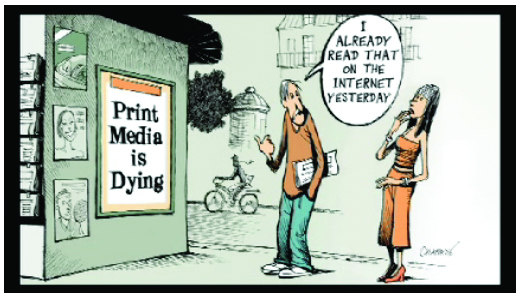
For decades, the rustle of a morning newspaper was the sound of a society waking up to information. Today, that sound has been replaced by the silent ping of a smartphone notification. There is no denying that print media, including newspapers, magazines, and journals, is facing an existential crisis. The meteoric rise of social media platforms such as Facebook, X (formerly Twitter), and TikTok has disrupted the traditional news model. To many, it appears that print media is not merely declining, but dying. Yet, is this the full story or simply the beginning of a new chapter?
2. Why Social Media Is Dominating
The primary advantage social media holds over print is immediacy. In the time it takes for a printing press to start, a story can already travel around the globe via a tweet or a viral video. Furthermore, social media is interactive. It allows for “citizen journalism,” where anyone with a smartphone can act as a reporter. This democratized flow of information has made traditional, gatekept media seem slow and outdated to younger, tech-savvy audiences.
Advertisers, the lifeblood of print journalism, have followed audience attention, shifting billions of dollars from physical pages to targeted digital advertisements.
3. Regional Resilience:
Pakistan, India, and the Islamic World
While the West has witnessed a sharp decline in print readership, a different narrative is unfolding in Pakistan, India, and across many Islamic countries. In South Asia, reading the newspaper remains a prestigious social tradition. In India, local language newspapers have seen growth in circulation, driven by rising literacy and regional engagement.
In Pakistan, where internet infrastructure remains inconsistent in rural areas, newspapers continue to serve as a powerful tool for political discourse and community representation.
Similarly, in Islamic countries such as Saudi Arabia, Turkey, and Egypt, print publications are often regarded as the most authoritative sources of official, legal, and religious narratives. In these societies, the printed word carries a level of institutional and moral credibility that fleeting social media posts cannot replicate. For millions, newspapers are not relics of the past but essential instruments of daily public life.
4. The Hidden Cost of Speed:
Misinformation
If social media’s greatest strength is speed, its greatest weakness is reliability. The phenomenon of “fake news” is a direct byproduct of the digital age. Algorithms prioritize engagement over accuracy, allowing misinformation to spread rapidly.
This is where print media finds renewed relevance. Newspaper articles undergo rigorous fact checking, legal review, and editorial oversight. In an era of digital chaos, the curated truth offered by print journalism has become a premium product for readers who value depth over instant headlines.
5. Adaptation: The Hybrid Future
The most successful media organizations have recognized that competing with social media on speed alone is futile. Instead, they compete on credibility and quality. This shift has given rise to a hybrid evolution. Media houses are no longer just publishers. They are digital ecosystems that use social platforms to guide audiences toward in-depth investigations and long-form analysis.
Their print legacy has transformed into a brand of trust, supported by newsletters, podcasts, and interactive content. This proves that while paper circulation may decline, journalism itself remains vibrant.
6. The Psychological and Historical Connection
Print media holds a psychological advantage that digital platforms struggle to replicate. Studies suggest that readers retain information more effectively when reading from paper than from screens. Moreover, print journalism serves as the first draft of history.
Digital archives are fragile and easily altered or erased. A physical newspaper, by contrast, stands as a permanent record of a society’s culture, politics, and struggles. It is a tangible legacy that survives long after servers fail or platforms change.
Conclusion:
Evolution, Not Extinction
To claim that print media is dying is an oversimplification. It is evolving. While the era of mass market general newspapers may be fading, the era of high-value, credible journalism is emerging. Print media is shifting from a commodity to a specialized, trusted service.
Social media tells us what is happening. Print media tells us why it matters. As long as societies value truth and depth, the essence of print journalism will continue to endure and transcend the medium of paper itself.
Reference Image:
Symbolic Evolution: The central visual depicts a traditional newspaper seamlessly transitioning into a modern smartphone, symbolizing the shift from physical to digital news formats.
Speed versus Substance: The image contrasts social media’s instantaneous nature with print media’s commitment to accuracy, regional resilience in places like Pakistan and India, and historical preservation.
The Power of Depth: The reference concludes with the insight that while social media provides immediate updates on events, print media offers the necessary depth to explain why those events truly matter.

