











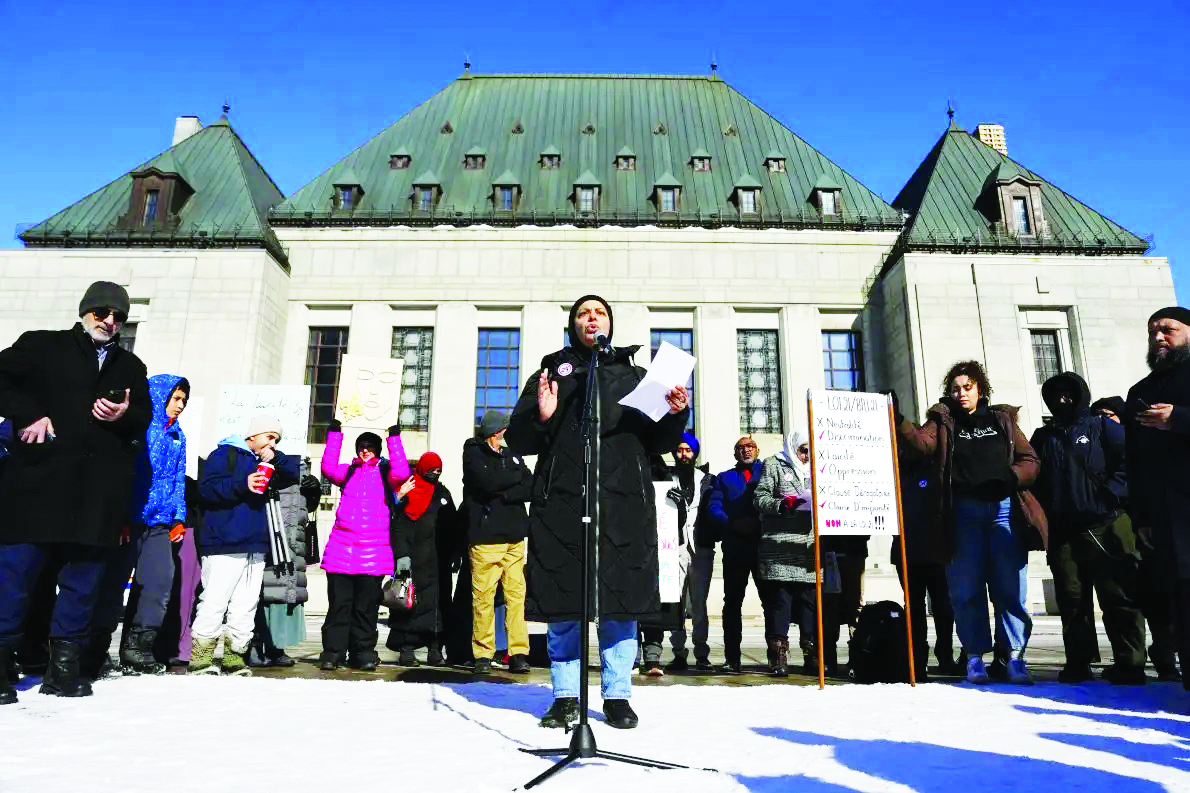
Last week, the Muslim community was front and centre in one of the most consequential legal cases in Canadian history.
The challenge to Quebec’s secularism law, Bill 21 (Ichrak Nourel Hak, et al. v. Attorney General of Quebec, et al) was heard over a historic 4-day hearing at the Supreme Court of Canada, with a record number of interveners (over 50) participating, including six Attorneys General. The outcome of this case will shape Canadian constitutional law for generations, and impact not just the religious freedom and equality rights of Muslim Canadians, but the fundamental freedoms of all Canadians.
What is Bill 21?
As a reminder, Bill 21 is a Quebec law that bans certain public sector workers in positions of authority (this includes teachers, lawyers, and police officers) from wearing religious symbols at work. In practice, it has disproportionately impacted Muslim women who wear the hijab, many of whom have been denied jobs, lost employment, or faced stalled careers. I know because I’ve personally reviewed many of their stories over the past 5 years, when they reached out to NCCM for assistance.
The law relies on the “notwithstanding clause”, which allows governments to override certain Charter rights for renewable five-year periods. This means that if a government invokes the notwithstanding clause, it can pass a law that violates the rights to religion, association, expression, life, liberty and security of the person, and equality (among others).
Our Role In Court:
NCCM participated as a party in this case. Our arguments focused on two key points:
1. First, that Bill 21 goes beyond Quebec’s authority by effectively regulating how religion can appear in public life (a matter of morality);
2. Second, governments cannot use ordinary legislation to make changes that impact the Constitution’s basic structure — including the principle that public institutions must remain open to people of all backgrounds. Those kinds of changes require a formal constitutional amendment, not the use of the notwithstanding clause.
Arguments in Court
The other parties opposing Bill 21 (6 groups in total) advanced a range of arguments. Some focused on the impact on minority communities, in particular English-speaking Quebecers whose institutions and culture reflect religious diversity. Others argued that the law is built on a misunderstanding of secularism, turning it into a tool for exclusion rather than neutrality.
On the other side, three parties, including the Quebec government, defended the law. They argued that courts should have no role in reviewing the use of the standing clause, not even to say whether rights have been violated. Quebec maintained that any court involvement would draw judges into political debates, and that the province acted within its powers in passing the law.
The Court also heard from over 50 interveners, reflecting a wide range of perspectives. Some provinces, like Alberta, supported limiting the role of courts, while others, like British Columbia, took a more balanced approach. The federal government argued that courts must retain a role in reviewing the use of the notwithstanding clause, especially given its temporary nature.
Many civil society organizations urged the Court to set clear limits or “guardrails” on how the notwithstanding clause can be used. One particularly powerful moment came when counsel for an intervener began by explaining that she was appearing because her hijabi colleague could not deliver submissions herself — a stark reminder of the real-world impact of this law.
What the Court Must Decide:
The judges have big questions to answer here. They include:
Are there any real limits on how governments can use the notwithstanding clause? Or do governments have absolute reign to restrict rights?
Can courts still play a role in reviewing its use, even if just to declare that a law is unconstitutional?
What safeguards, if any, remain if governments choose to override certain Charter rights?
These are the big questions the court will be forced to answer, and their answers will define the strength of our rights and our role in this country.
Now that the hearing is over, we expect to wait several months for a decision.
What’s at Stake?
This case will have lasting consequences, for Muslim and non-Muslim communities alike. It will determine whether citizens and courts would be powerless if a future government (any government, even outside of Quebec) were to criminalize criticism of the state, legalize discrimination, torture, or slavery, or any manner of law.
This case will shape not only the future of constitutional law in Canada, but also how Muslim communities engage in advocacy, public life and civic participation in this country.
The stakes could not be higher, and the impact will be felt for generations to come.
We are deeply grateful to all our supporters and donors who have stood with us throughout this journey, and most especially to the impacted Muslim women who have been the face of this law and been at the front lines in fighting it. We are also thankful to our counsel team at IMK LLP for their tireless work.
Your support has made this work possible. No matter the outcome, we will forge a path forward together inshaAllah.
Sent By: Nusaiba Al-Azem